The single biggest myth in fitness is that a workout has to be long to count. It does not. When you are short on time, the answer is not a longer session you will skip anyway. It is a shorter one you will actually finish. You do not need an hour. You need intensity and structure.
Do short workouts actually work?
Yes. A focused 7 to 15 minutes of real effort beats an hour of wandering between machines on your phone. Research on high-intensity interval training has repeatedly shown that brief, hard sessions improve cardiovascular fitness and conditioning. The two ingredients that make short work pay off are intensity (you go genuinely hard during the work bursts) and structure (you follow a fixed clock instead of guessing).
Structure is the part most people miss. The moment you are deciding how long to rest, checking the time, or wondering if that was thirty seconds, the workout leaks. The fix is to let a timer run the session so your only job is to move. Below are five formats that respect your time, with sample sessions you can copy.
What are the best short workout formats?
1. Classic Tabata (4 minutes)
Tabata is the original time-crusher: 20 seconds all out, 10 seconds rest, repeated for 8 rounds. That is exactly 4 minutes per exercise. It comes from research by Dr. Izumi Tabata and his colleagues, and the rules are strict on purpose. The 20 seconds are supposed to be hard, not pleasant.
Pick one movement and commit to it: bodyweight squats, burpees, mountain climbers, high knees, or kettlebell swings. Stack two or three Tabata blocks with a minute between them and you have a complete session in well under fifteen minutes.
2. The 7-minute workout
The 7-minute workout is a circuit of 12 bodyweight exercises, each done for 30 seconds with about 10 seconds to switch. It became famous after a write-up in a major fitness journal, and its appeal is obvious: no equipment, no excuses, done before your coffee cools. Order it so you alternate muscle groups (a lower-body move, then upper, then core) which lets each area recover while the next works.
A standard run looks like jumping jacks, wall sit, push-ups, crunches, step-ups, squats, triceps dips, plank, high knees, lunges, push-up with rotation, and side plank. Loop it twice if you have fourteen minutes and want more.
3. EMOM (you choose the length)
EMOM means Every Minute On the Minute. At the top of each minute you do a set number of reps, then rest for whatever is left in that minute. Finish fast, rest more. Finish slow, rest less. It is self-pacing, which makes it forgiving for beginners and brutal for the ambitious.
Try 10 minutes: 10 kettlebell swings at the top of every minute. Or alternate, odd minutes 12 push-ups, even minutes 15 air squats. The clock does all the thinking, so you just chase the rep count.
4. A 10 to 15 minute HIIT circuit
When you have a bit more room, a short HIIT circuit gives you variety without bloat. Use 40 seconds of work and 20 seconds of rest across four or five exercises, repeated for two or three rounds. The slightly longer work window suits compound moves that need a second to set up, like reverse lunges or renegade rows.
This is the format most people picture when they say HIIT, and it is the sweet spot for a lunch break: long enough to feel like a real session, short enough that you are showered and back at your desk inside half an hour.
5. Japanese interval walking (low impact)
Not every quick workout has to leave you on the floor. Japanese interval walking alternates 3 minutes of brisk walking with 3 minutes of easy walking, repeated for about 30 minutes. Developed by researchers in Japan, it is dramatically more effective than strolling at one comfortable pace, and it is kind to your joints. If 30 minutes is too much today, even three or four cycles still beats a flat walk.
The catch with interval walking is the same as with Tabata: it only works if you honor the change every 3 minutes, and staring at your watch ruins the rhythm. This is exactly where a hands-free timer earns its place.
| Format | Time | Structure |
|---|---|---|
| Classic Tabata | 4 min per block | 20s work / 10s rest x 8 |
| 7-minute workout | 7 min | 12 moves, 30s work / 10s switch |
| EMOM | 10 to 20 min | Set reps each minute, rest the remainder |
| Short HIIT circuit | 10 to 15 min | 40s work / 20s rest, 2 to 3 rounds |
| Interval walking | ~30 min | 3 min brisk / 3 min easy, repeat |
Two sample sessions you can copy
Here are two ready-to-run sessions. Set them up once and reuse them forever.
The 12-minute no-equipment burner
- Warmup: 60 seconds easy (march in place, arm circles).
- Tabata block 1: bodyweight squats, 20s on / 10s off x 8 (4 min).
- Rest: 60 seconds.
- Tabata block 2: push-ups and mountain climbers, alternating, 20s on / 10s off x 8 (4 min).
- Cooldown: 90 seconds easy stretch.
The lunch-break HIIT circuit
- Warmup: 90 seconds (high knees, leg swings).
- Circuit (40s work / 20s rest), 3 rounds: reverse lunges, push-ups, kettlebell or dumbbell swings, plank shoulder taps, jump squats.
- Cooldown: 2 minutes walking and stretching.
That circuit lands at about 17 minutes with warmup and cooldown. Drop to two rounds and you are under 13. The point is that the timing is fixed in advance, so once you press start you never have to make another decision.
How do you run all of these hands-free?
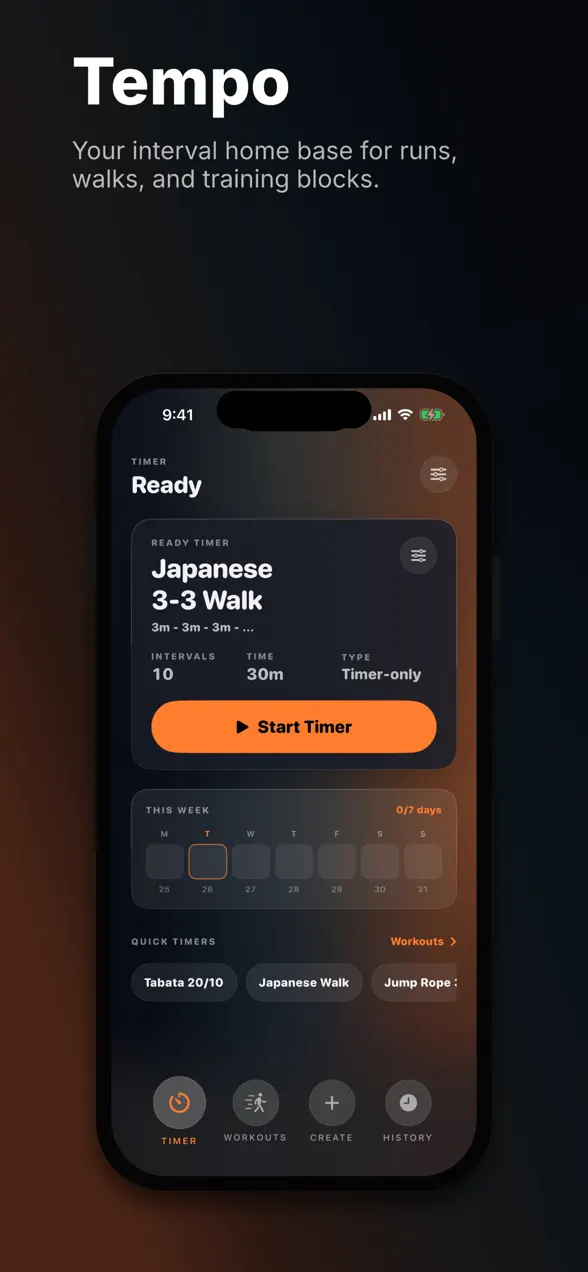
Every format above lives or dies on timing, and the worst way to keep time is by glancing at a clock between burpees. That is the gap Interval Timer: Tempo is built to fill. You build a session out of work, rest, warmup, cooldown, and repeat groups, then let it run while you train.
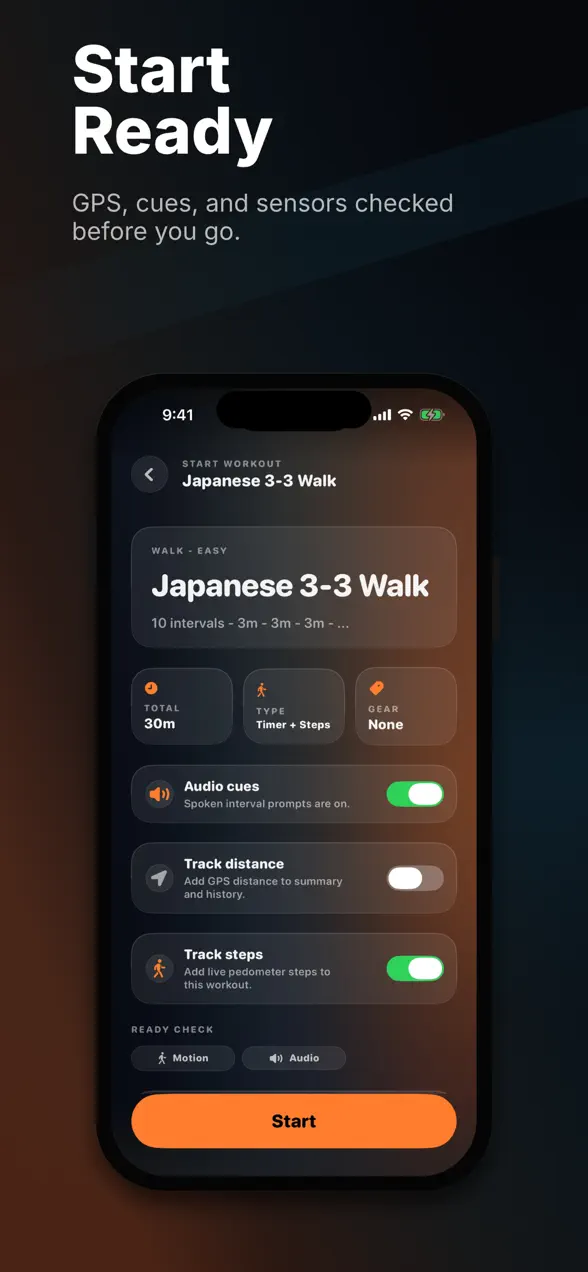
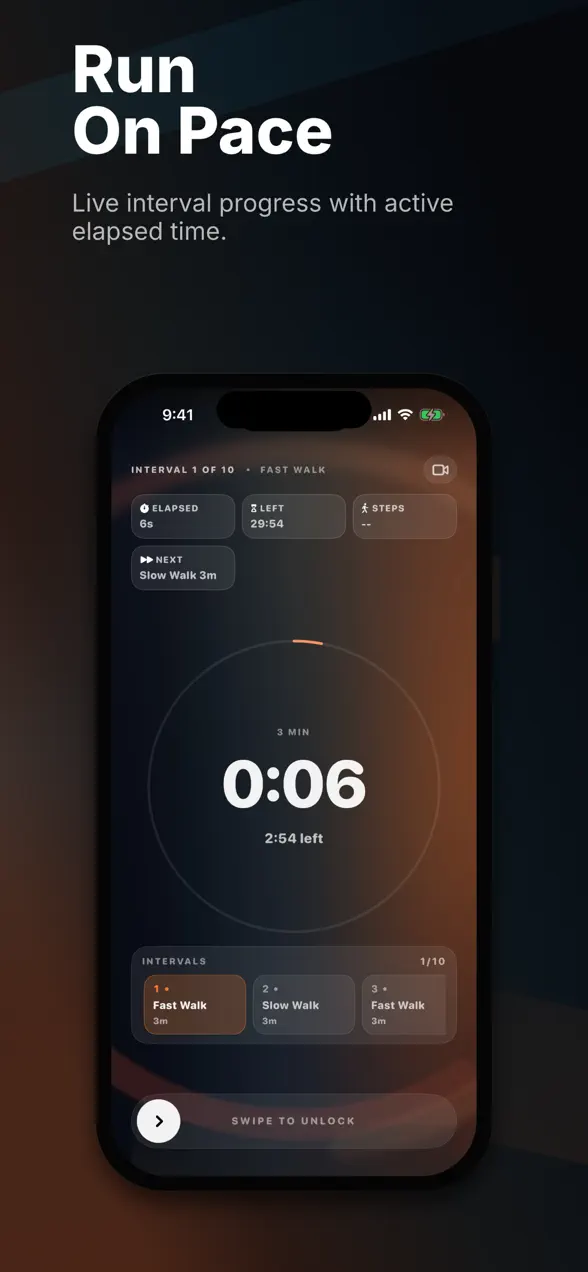
Tempo handles all five formats from a single app. There is a Tabata preset for the 20/10 x 8 structure, easy custom builders for a 7-minute circuit or an EMOM, and a ready-made Japanese interval walking timer (3 minutes fast, 3 minutes easy, for 30 minutes). It fires audio cues and haptics on every interval change, and those cues keep working with the screen locked or while another app is open, so your music keeps playing and you never miss a switch.
Why these workouts need a real timer (and how Tempo helps)
Every format above is really a set of timing rules, and the rules only do their job if something keeps them honest. That is the role Interval Timer: Tempo plays, mapping cleanly onto each of these short sessions.
- Honor the timing. The whole point of intervals is respecting the clock, so Tempo's presets plus custom work, rest, warmup, cooldown, and repeat groups let you build Tabata or any format in seconds.
- Stay hands-free. You should not be watching a clock mid-set, so audio and haptic cues fire on every interval change and keep working with the screen locked or another app open.
- Actually finish. A short session only counts if you complete it, so a large, glanceable display shows the current interval, time left, and what is next, with optional GPS distance and Apple Health metrics for run-walk formats.
The science of short workouts only pays off if you actually run the clock, and that is the friction Tempo removes.
The mindset that makes it stick
The real win of short workouts is not the four minutes of Tabata. It is that a four-minute session is hard to talk yourself out of. Consistency comes from sessions small enough to start on a busy Tuesday, and intensity comes from going genuinely hard while the clock runs. Get both and you out-train most people who keep waiting for a free hour that never arrives.
Pick one format, copy one sample session, and set your timer up tonight. Tomorrow you press start and move. That is the whole secret.
Frequently asked questions
Can a short workout actually make a difference?
Yes. Research on high-intensity interval training has repeatedly shown that short, hard sessions can improve cardiovascular fitness and conditioning. The key is intensity and structure: a focused 7 to 15 minutes of real effort beats an hour of half-hearted movement.
What is a Tabata workout?
Tabata is a specific interval format: 20 seconds of all-out work followed by 10 seconds of rest, repeated for 8 rounds. That is exactly 4 minutes per exercise. It comes from research by Dr. Izumi Tabata and is one of the most time-efficient ways to push your conditioning.
What does EMOM mean?
EMOM stands for Every Minute On the Minute. At the top of each minute you perform a set number of reps, then rest for whatever time is left in that minute. Finish faster and you earn more rest, which makes the workout self-pacing and easy to scale.
What is Japanese interval walking?
Japanese interval walking alternates 3 minutes of brisk walking with 3 minutes of easy walking, repeated for about 30 minutes. Developed by researchers in Japan, it is a low-impact way to build fitness without running, and it is far more effective than walking at one steady, comfortable pace.