Walking is the most accessible exercise there is, but how you walk decides whether it just keeps you ticking over or genuinely makes your heart and lungs stronger. The difference comes down to intensity. Add short, brisk pushes to your walk and research suggests you can raise your VO2 max, a leading marker of long-term health, without ever setting foot in a gym. Here is the science, a simple progressive plan, and the easiest way to time the intervals.
What is VO2 max and why does it matter?
VO2 max is the maximum rate at which your body can take in and use oxygen during hard effort. It is the headline number for cardiorespiratory fitness, how well your heart, lungs, and muscles work together when you push.
Why care about a number most of us never measure in a lab? Because research consistently links higher cardiorespiratory fitness with better long-term health and longevity. It is one of the strongest predictors we have.
You may already be tracking it without realising. Apple Watch estimates VO2 max and shows it as "Cardio Fitness," quietly building a trend from your walks, runs, and hikes.
- It reflects your engine size. A higher VO2 max means everyday effort, stairs, hills, carrying bags, feels easier.
- It trends over time. Single readings wobble, so watch the direction across weeks and months, not day to day.
- It responds to training. Research suggests beginners and less-fit people tend to see the biggest gains when they add structured effort.
Why do intervals raise VO2 max more than easy steady walking?
Steady, comfortable walking is wonderful for general health, mood, and consistency. But VO2 max responds most to higher-intensity effort, and an easy stroll rarely reaches the intensity that pushes your heart and lungs to adapt.
Intervals solve this. By alternating short, hard pushes with easy recovery, you spend real time at an intensity that challenges your aerobic system, then recover enough to do it again. Those brisk three-minute pushes are the actual stimulus.
This is also why simply chasing a step target can fall short for fitness. A big day of steps at one gentle pace builds the habit and the volume, but it lighter on the intense stimulus that drives VO2 max. If you want the full picture, see our breakdown of Japanese walking versus 10,000 steps.
VO2 max trend over a 12-week interval walking block
Illustrative, not exact data. Results vary, and research suggests beginners tend to gain the most, often early in a training block.
What is the Japanese 3-3 interval walking method?
The cleanest way to add intensity to a walk comes from Japan. Interval Walking Training, often called Japanese interval walking, was developed by researchers at Shinshu University (Nose, Masuki, and Nemoto).
The protocol is refreshingly simple. You alternate three minutes of fast walking at a "somewhat hard" effort with three minutes of gentle walking, and repeat for about five cycles, roughly 30 minutes, about four or more days a week.
Studies have reported gains in aerobic capacity (VO2 peak, often around 10 percent or more), leg strength, and blood pressure. Research suggests it generally beats continuous moderate walking and beats simply hitting a step target, while needing no equipment beyond a timer.
Here is how to run a single session, start to finish:
- Warm up. Walk easy for three to five minutes to loosen up.
- Push. Walk fast for three minutes at a "somewhat hard" effort, the pace where talking in full sentences gets difficult.
- Recover. Drop to a gentle, comfortable pace for three minutes. You should feel ready to push again by the end.
- Repeat. Alternate fast and slow for about five cycles, roughly 30 minutes total.
- Cool down. Finish with two to three minutes of easy walking.
How do I progress over the weeks?
You do not have to start at five full cycles four days a week. The smart move is to build gradually so the habit sticks and your joints keep up. Beginners tend to see the fastest improvements anyway, so there is no need to rush.
| Week | Fast / slow split | Days / week | Focus |
|---|---|---|---|
| 1 to 2 | 2 min fast / 3 min slow, 3 cycles | 3 | Find your "somewhat hard" pace |
| 3 to 4 | 3 min fast / 3 min slow, 4 cycles | 3 to 4 | Settle into the rhythm |
| 5 to 8 | 3 min fast / 3 min slow, 5 cycles | 4 | Hit the full protocol |
| 9 to 12 | 3 min fast / 3 min slow, 5 cycles | 4 to 5 | Walk the fast blocks faster |
A few tips to gauge effort and stay safe as you build:
- Use the talk test. During fast blocks you should be able to say a few words but not hold a full conversation. During slow blocks you should recover comfortably.
- Let heart rate confirm it. If you wear a watch, the fast blocks should noticeably lift your heart rate and the slow blocks should let it settle.
- Progress one thing at a time. Add a cycle, add a day, or walk the pushes faster, but not all at once.
- Check with a doctor first if you are new to exercise, are returning after a long break, or have any heart or blood pressure concerns. Stop and seek advice if you feel chest pain, dizziness, or unusual breathlessness.
How does Tempo make the intervals effortless?
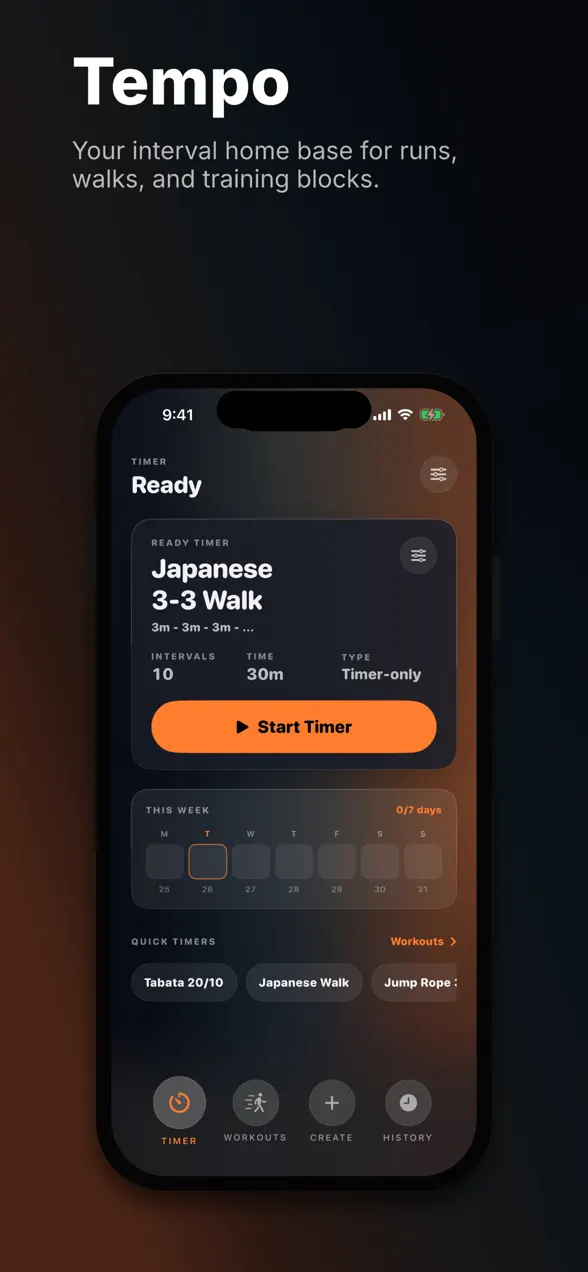
The hardest part of interval walking is not the walking. It is keeping track of two repeating three-minute timers while you are out of breath and watching the path ahead. That is exactly the job a good timer should take off your hands.
Interval Timer: Tempo is a free iOS app built for precisely this rhythm of work and rest.
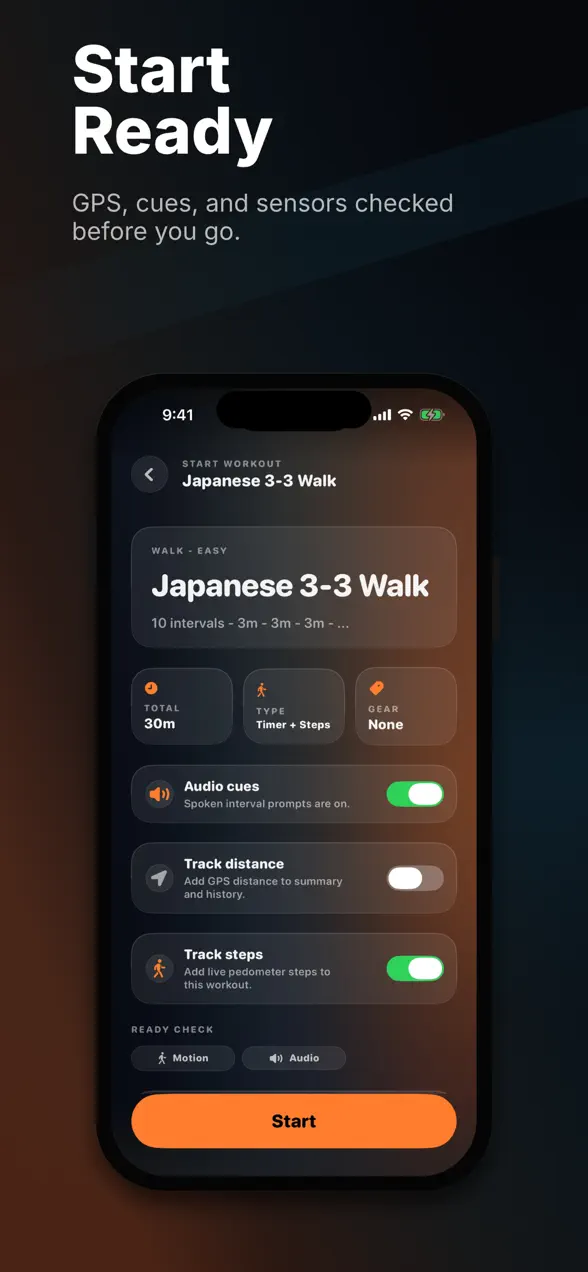
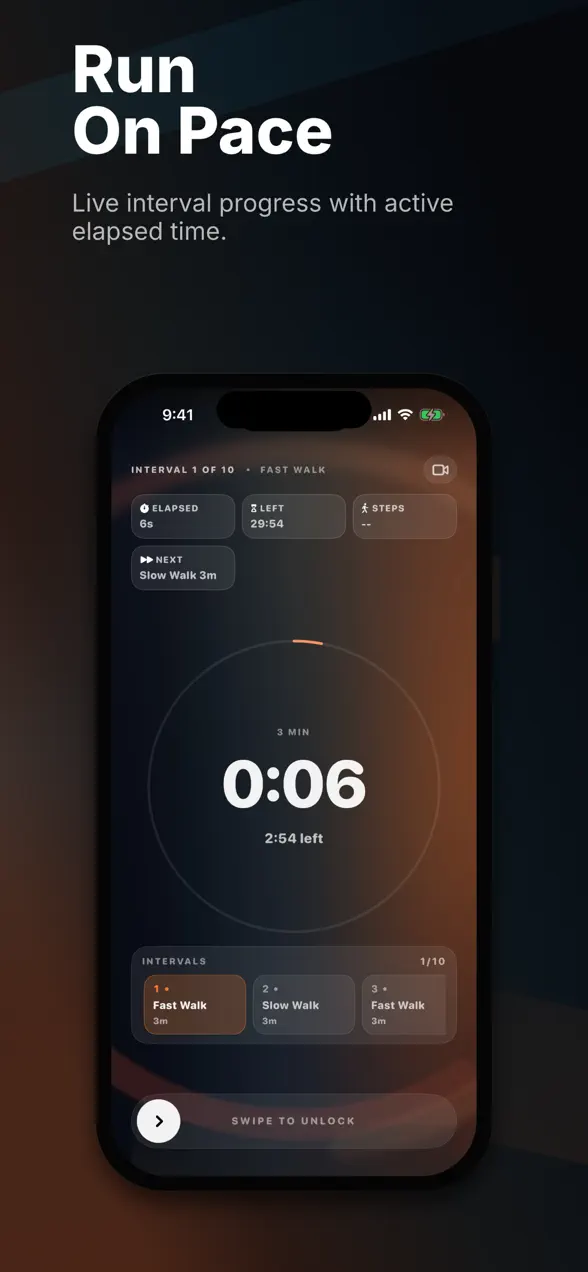
- Hands-free cues. Audio and haptic signals fire on every switch, even with the screen locked or your phone in a pocket, so you never have to look.
- Ready-made presets. Set up a 3-minutes-fast, 3-minutes-slow loop once and reuse it, or start from a preset.
- A large, readable display. When you do glance down, the current interval, time left, and what is next stay big and clear.
- Optional heart rate and distance. Turn on Apple Health metrics and GPS to see heart rate, pace, and distance for each walk, opt-in and private.
Prefer a pure step counter for your easy days? Simply Step pairs nicely, tracking volume while Tempo handles intensity.
Putting it together
You do not need to run, buy equipment, or train for hours to build a stronger heart and a higher VO2 max. Research suggests that adding structured three-minute pushes to a walk you already enjoy can do a lot of the work.
Start light, progress one step at a time, watch your Cardio Fitness trend over weeks, and let a timer handle the counting. The walk is the workout. You just have to push when it says push.
Frequently asked questions
Can walking really improve my VO2 max?
Research suggests it can, as long as the walking includes higher-intensity efforts. Studies on Japanese interval walking, where you alternate three minutes of fast walking with three minutes of gentle walking, have reported gains in aerobic capacity of roughly 10 percent or more. Easy steady strolling is great for general health but provides less of the stimulus that raises VO2 max.
How often should I do interval walking?
The original protocol calls for about four or more days a week, with roughly five cycles of fast and slow walking per session, which works out to about 30 minutes. Beginners can start with two or three days and fewer cycles, then build up over several weeks as it gets easier.
What is Cardio Fitness on Apple Watch?
Cardio Fitness is Apple's estimate of your VO2 max, the maximum rate your body can use oxygen during hard effort. Apple Watch estimates it from your heart rate and motion during walks, runs, and hikes. It is a useful trend line to watch over weeks rather than a lab-grade single reading.
Do I need any equipment for interval walking?
No. You only need a way to time the intervals. A free interval timer app like Tempo gives you hands-free audio and haptic cues for each three-minute switch, so you can keep your eyes up and just walk. Optional heart rate and distance come from Apple Health if you choose to enable them.
