Two walking goals have taken over fitness feeds: hit 10,000 steps, or do "Japanese walking" (three minutes fast, three minutes slow, repeat). They sound similar because both are just walking. But they train your body in very different ways, and research suggests one of them gives you noticeably more fitness for the same time on your feet. Here is the honest comparison, plus how to do the interval version with a free timer.
What is Japanese interval walking?
Japanese interval walking, formally called Interval Walking Training, was developed by researchers at Shinshu University in Japan (Nose, Masuki, and colleagues). The idea is simple: swap one steady pace for a rhythm of hard and easy.
The protocol that the studies used looks like this:
- 3 minutes brisk at a "somewhat hard" effort, where talking in full sentences gets difficult.
- 3 minutes easy at a relaxed, recovery pace.
- Repeat about 5 cycles, which lands at roughly 30 minutes total.
- Do it 4 or more days a week to see the reported benefits.
Studies on this method have reported gains in aerobic capacity (often measured as VO2 peak), leg strength, and blood pressure, generally beating continuous moderate walking. Some of that work has reported VO2 peak improvements in the region of 10 percent or more over several months, along with measurable drops in resting blood pressure. Research suggests beginners and older adults tend to improve the most, partly because they start with the most room to grow.
The mechanism is not mysterious. The brisk blocks push your heart rate up into a training zone, then the easy blocks let it settle just enough to go hard again. That repeated stretch-and-recover pattern is what trains the cardiovascular system, and it is why the same 30 minutes can do more than a flat, steady stroll of the same length.
What does "10,000 steps" really mean?
The 10,000 step target is a volume goal. It counts how much you move across the whole day, usually at one comfortable, steady pace, regardless of how hard any single stretch feels.
That makes it a fantastic measure of general daily activity and consistency. It nudges you off the couch, breaks up long stretches of sitting, and quietly adds up over the day. What it does not do is deliberately push intensity, and intensity is the lever that drives most fitness adaptation. For more on where the number actually came from (a 1960s pedometer marketing slogan, not a lab), see our look at whether 10,000 steps a day is a myth.
None of that is a knock on steps. Daily movement is genuinely protective, and for someone going from mostly sedentary to consistently active, hitting a step target is one of the highest-value habits there is. It is simply a different tool: it measures how much you moved, not how hard.
How are the two approaches actually different?
The short version: one optimizes for intensity, the other for volume. Here is how they line up side by side.
| Japanese walking | 10,000 steps | |
|---|---|---|
| Time | About 30 minutes | Spread across the whole day |
| Intensity | Alternating hard and easy | One steady, comfortable pace |
| Main benefit | Aerobic fitness, leg strength, blood pressure | General activity, consistency, NEAT |
| Equipment | Just a timer | A step counter or phone |
| Best for | Building measurable fitness fast | Staying active all day |
Because the brisk blocks push your heart and lungs harder, interval walking targets heart health and VO2 max more directly than steady strolling does. VO2 max, the maximum rate your body can use oxygen during hard effort, is one of the strongest markers of long-term health, and research suggests it responds best to higher-intensity efforts rather than only easy movement.
Relative fitness gain per 30 minutes
Illustrative, not exact data. It shows the general pattern research suggests: adding brisk intervals tends to drive more aerobic gain per minute than steady-pace walking.
So which one wins?
For pure fitness built per minute, the fair verdict goes to Japanese interval walking. Research suggests it tends to deliver more improvement in aerobic capacity, leg strength, and blood pressure in less total time, because the brisk blocks supply the higher-intensity stimulus that steady walking lacks.
That does not make 10,000 steps pointless. The two answer different questions:
- Choose Japanese walking when your goal is measurable fitness, you are short on time, or you want a structured session 4-plus days a week.
- Choose the 10,000 step habit when your goal is to move more overall, sit less, and keep daily activity high.
- Combine them for the best of both: bank your steps across the day, and turn 30 of those minutes into 3-3 intervals a few times a week.
They are complements, not rivals. The interval session sharpens fitness; the step count keeps you generally active. A simple weekly shape might be three or four Japanese walking sessions slotted into days you already walk, with the step habit running quietly underneath the whole week.
One more practical point: interval walking is also easier to stick with than it sounds. Thirty focused minutes with a clear structure tends to feel shorter than an open-ended march toward a step number, and the changing pace keeps your mind engaged instead of zoning out.
How do you do Japanese walking with Tempo?
The only real friction in interval walking is timing the switches. Glancing at a clock every three minutes ruins the rhythm. Interval Timer: Tempo handles that for you, signaling each change with sound and haptics so you can keep your eyes up and your hands free.
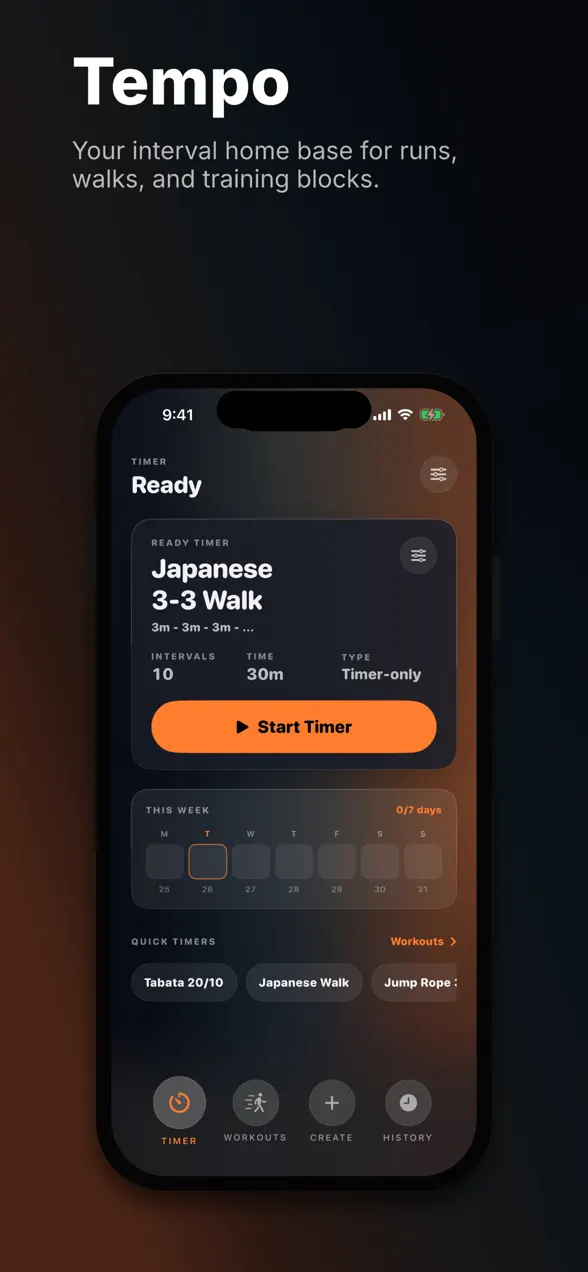
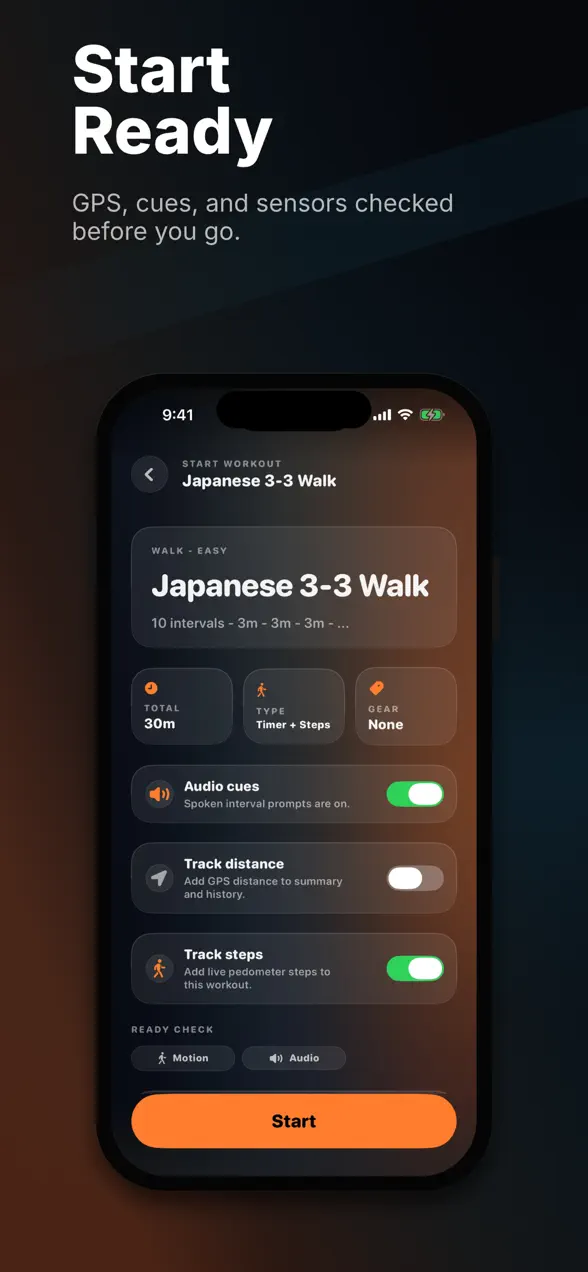
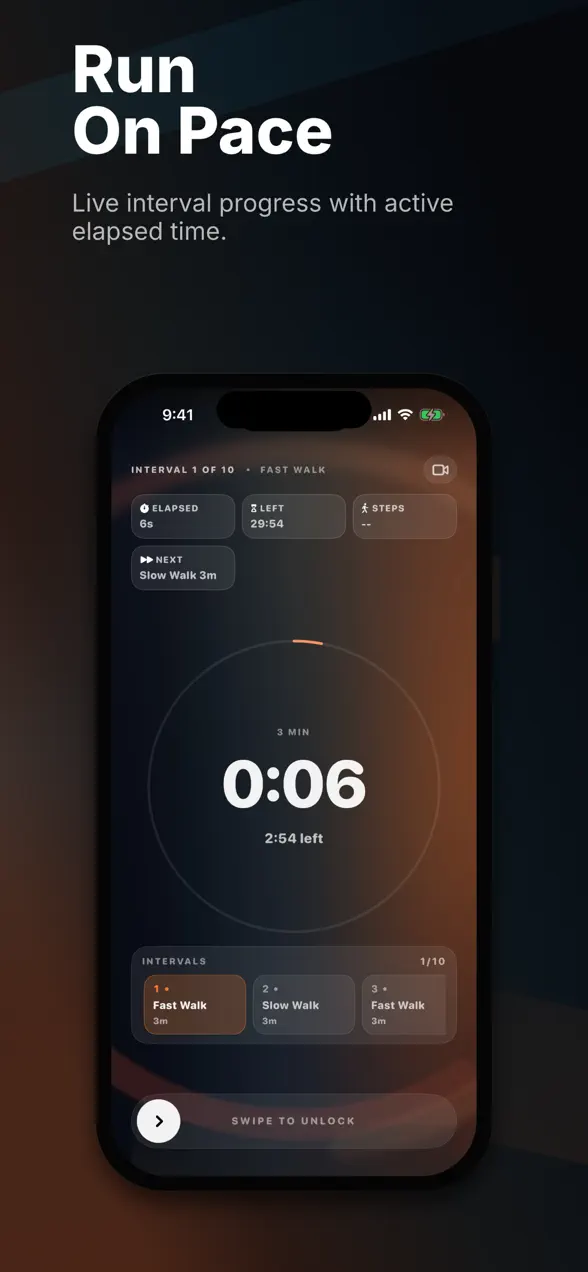
Here is the full setup:
- Open Tempo and create a new timer for your walk.
- Add a brisk interval set to 3 minutes, then an easy interval set to 3 minutes.
- Set the pair to repeat 5 times, which gives you about 30 minutes.
- Label them ("Brisk" and "Easy") so the on-screen cue tells you what is coming next.
- Optionally turn on GPS distance and Apple Health metrics to log the walk.
- Press start and walk. Tempo times the 3-3 intervals hands-free, cueing every switch with sound and haptics, even with your screen locked.
That is the whole method: let the timer think about the clock so you can think about your pace.
Frequently asked questions
What is Japanese interval walking?
Japanese interval walking, also called Interval Walking Training, alternates 3 minutes of fast walking at a "somewhat hard" effort with 3 minutes of gentle, easy walking. You repeat that for about 5 cycles, roughly 30 minutes, on 4 or more days a week. It was developed by researchers at Shinshu University in Japan.
Is Japanese walking better than 10,000 steps?
For building fitness, research suggests interval walking tends to deliver more gain in aerobic capacity, leg strength, and blood pressure per minute spent, because it adds intensity. The 10,000 step target is excellent for general daily activity and consistency. The two are not rivals and combine well.
How hard should the fast intervals feel?
Aim for "somewhat hard." You should be breathing noticeably harder and able to speak only in short phrases, not full sentences. The easy 3 minutes should feel genuinely relaxed so you recover before the next brisk block.
Do I need any equipment for Japanese walking?
No. You only need a way to time the 3 minute intervals. A free interval timer like Interval Timer: Tempo signals each switch with sound and haptics so you can keep your eyes up and your hands free while you walk.